
.svg)
2026 PD Wrap Up: The Space Between Knowing and Doing
Sue Chandler, Founder of Transformative Schools presents the Relational Practice Bridge, a framework for shifting school culture from control to curiosity. Through three "stories" (the discipline biographies we inherit, the theories of change we adopt, and the patterns our systems reinforce), she explores why relational practice is hard to sustain and how educators can build genuine accountability through understanding rather than consequences.
Author/Source: PESA and Sue Chandler, Transformative Schools
Last updated: 07/08/2026

A framework for transforming school culture, built on two foundational pillars:
-
Organisational readiness: the strategic planning behind relational work, including shared understanding, the people appointed to lead it, and whether space and time have been deliberately created for it to succeed.
-
Relational thinking: the mindset and skills that sit alongside readiness encompassing practices of care, student and family voice, and the policies and documentation that either support or undermine a school's stated values (Chandler, 2026).
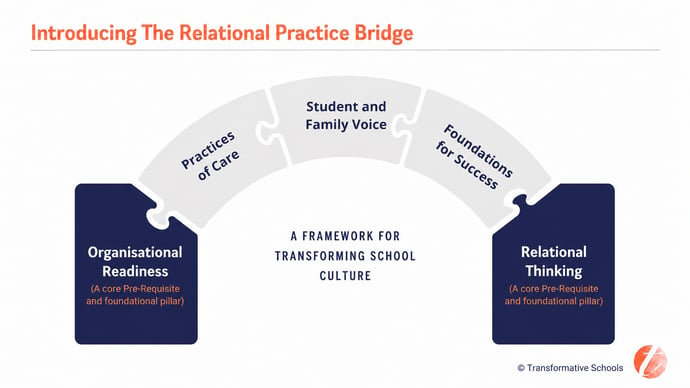
The bridge isn't meant to be worked through in a fixed sequence, any part of it can be examined and strengthened independently, over time.
Three Stories of Relational Thinking/ Mindset
|
Story |
Key Idea |
|
1. Stories we inherited |
Our own "biography of discipline" quietly shapes how we respond to behaviour today (Desautels, 2022) |
|
2. Stories we adopted |
Two theories of change: the legacy pathway (control-based i.e. accountability through consequences) vs. the relational pathway (capability-base i.e. accountability through understanding, skill-building, shared responsibility) |
|
3. Stories our systems reinforce |
School systems shape (but don't determine) whether we lean toward compliance vs. capability, evidence vs. understanding, and certainty vs. curiosity |
Story One: The Stories We've Inherited
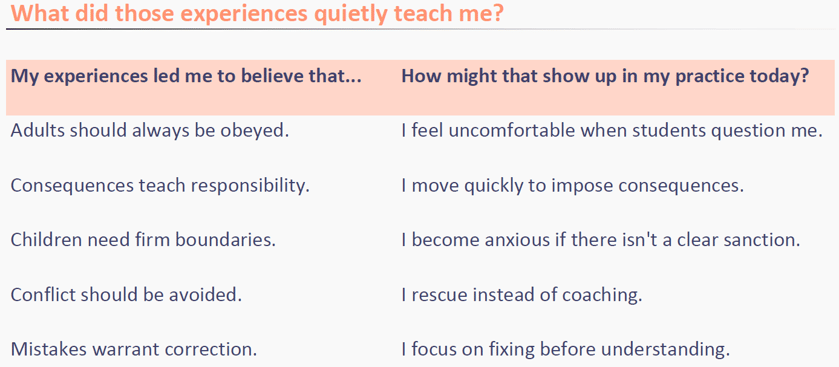
Every educator carries a personal "biography of discipline" - inherited beliefs, upbringing and past experiences that shape how they respond to student behaviour, often without conscious awareness (Desautels, 2022). Reflective questions in this space include how a person was disciplined as a child, how they felt afterwards, and whether repair with the disciplining adult ever took place.
These early experiences quietly become beliefs about how people become capable, for example, that adults should always be obeyed, that consequences teach responsibility, or that conflict should be avoided. Left unexamined, those beliefs continue to show up in adult practice: discomfort when students question authority, a quick reach for consequences, or a tendency to rescue rather than coach. Unless these inherited stories are surfaced, new relational practices and policies are unlikely to be sustained, because default patterns tend to resurface under pressure.
Copyright: Transformative Schools
Story Two: Two Pathways to Accountability
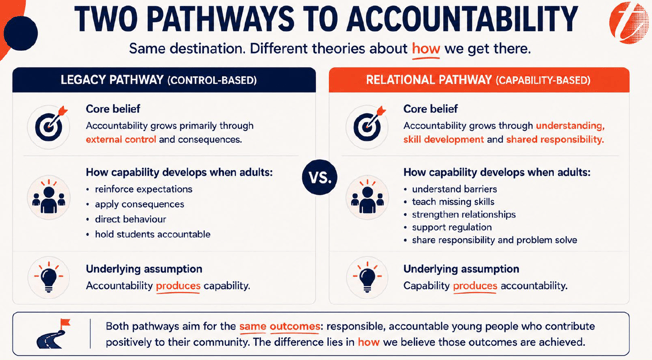
Beneath every response to behaviour sits a theory about how people change. Two contrasting pathways were outlined:
-
The legacy pathway (control-based): accountability grows through external control and consequences - reinforcing expectations, applying consequences, directing behaviour. The underlying assumption is that accountability produces capability.
-
The relational pathway (capability-based): accountability grows through understanding, skill development and shared responsibility - understanding barriers, teaching missing skills, strengthening relationships, supporting regulation. The underlying assumption is that capability produces accountability.
Both pathways aim for the same outcome - responsible, accountable young people - but differ in how that outcome is believed to be achieved.
Copyright: Transformative Schools
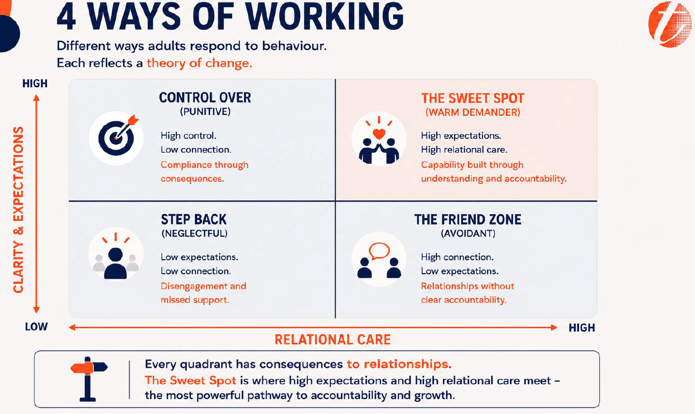
This maps onto a four-quadrant model of educator responses, plotting relational care against clarity of expectations:
Copyright: Transformative Schools
A useful reframe here is Ross Greene's observation that a consequence is "simply something that happens after the fact " (Greene, 2021) which opens space to ask what kind of response, rather than what consequence, will genuinely build accountability. Ross Greene's approach is also discussed in Michelle McKersey's 2026 webinar for PESA: A Whole School Approach to Restorative Practices. Watch the session below.
The Space Between Knowing and Doing
Presented by Sue Chandler, Founder of Transformative Schools.
Why Relational Practice Requires a Shift from Control to Curiosity.
Last updated: 06/08/2026

A Whole School Approach to Restorative Practices
Presented by Michelle McKersey: Deputy Head of Secondary (Students), Moreton Bay College.
Shifting from rules to relationships and from conflict to connection.
Last updated: 26/07/2026

Story Three: The Stories Our Systems Reinforce
School systems such as policies, processes, and everyday expectations, quietly shape professional habits, even though they don't remove professional judgement. Several continuums illustrate this:
-
What a system is ultimately trying to develop: compliance (stop the behaviour, follow directions) vs. capability (build regulation, strengthen problem-solving).
-
What information a system invites staff to gather: evidence (what happened, who was involved, what rule was broken) vs. understanding (what was happening for the student, what's getting in the way).
-
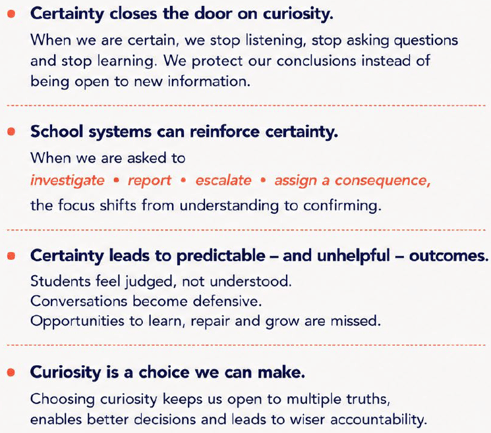
What kind of thinking a system encourages: certainty (I know what happened, I know why) vs. curiosity (what am I missing, what else might be true).
-
What most influences what happens next: a predetermined process vs. a conversation that genuinely shapes the response.
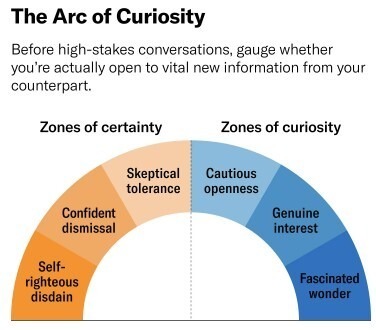
Certainty closes the door on curiosity - when we're certain, we stop listening and stop learning, and conversations can become defensive rather than productive. Jeff Wetzler's Curiosity Curve (Wetzler, 2024) maps this spectrum, from self-righteous disdain and confident dismissal at the certainty end, through to genuine interest and fascinated wonder at the curiosity end. Choosing curiosity is presented as a deliberate act, not a natural default - one that keeps people open to multiple truths and supports wiser, more relational decisions.
Copyright: Transformative Schools
Another approach is the Collaborative Spirit Approach, which draws on Ross Greene's Collaborative and Proactive Solutions (CPS) model, a simple three-part structure supports relational conversations about behaviour:
-
You: invite the young person's perspective.
-
Me: share your own perspective with clarity and respect.
-
Us: plan a way forward together.
This approach also supports a "warm handover" when a matter needs to be referred further up a school's system - helping preserve or strengthen the relationship with the student, rather than simply escalating the issue. This also links to Michelle McKersey's earlier webinar mentioned above so check it out!
Key Takeaways
-
Relational culture change requires attention to both organisational readiness and relational mindset.
-
Personal "discipline biographies" strongly influence how educators respond to behaviour, especially under pressure.
-
Building capability and understanding, rather than simply applying consequences is more likely to produce genuine accountability.
-
School systems shape but don't determine an educator's response; individuals retain professional judgement and choice.
-
Curiosity is a skill that takes deliberate practice, particularly under the certainty pulled by high-stakes conversations.
Related Resources
2026 PD Wrap Up: Connection IS The Content: A Pathway to Wellbeing
Curiosity Check and the Ask Approach

Communicating with Today's Parents: McCrindle Research and RoundTable

Connection IS The Content: A Pathway to Wellbeing
2026 PD Wrap Up: The Space Between Knowing and Doing
The Space Between Knowing and Doing
A Whole School Approach to Restorative Practices
2026 PD Wrap Up: A Whole School Approach to Restorative Practices
.png)
Creating a Wellbeing Environment: Positive Leadership Practices
2026 PD Wrap Up: Connection IS The Content: A Pathway to Wellbeing
Curiosity Check and the Ask Approach
Communicating with Today's Parents: McCrindle Research and RoundTable
Connection IS The Content: A Pathway to Wellbeing
2026 PD Wrap Up: The Space Between Knowing and Doing
The Space Between Knowing and Doing
A Whole School Approach to Restorative Practices
2026 PD Wrap Up: A Whole School Approach to Restorative Practices