2026 PD Wrap Up: A Whole School Approach to Restorative Practices
Building on our Term 1 focus on creating a strong community from day one, we welcomed Michelle McKersey, Deputy Head of Secondary at Moreton Bay College to explore a whole‑school approach to restorative practice. In this session, Michelle contrasted restorative, relational approaches to behaviour with traditional punitive models and highlighted Collaborative Problem Solving (CPS) as a proactive, preventative strategy within a restorative framework.
Author/Source: PESA and Michelle McKersey, Moreton Bay College.
Last updated: 26/07/2026
At PESA, our learning focus for Term 1, 2026 is simple yet impactful: putting people at the centre of everything we do. Reconnecting staff, students, and families is the foundation of a vibrant, inclusive community, and it begins with the understanding that staff wellbeing is the bedrock of a healthy learning environment.
We were recently joined by Justin Robinson, Director and Co-Founder of The Wellbeing Distillery, for an online masterclass on ‘Building a Shared Responsibility for Teacher Wellbeing’, where he shared the Wellbeing Quadrant, a practical framework designed to promote wellbeing and proactively prevent ill-being. Below, we have synthesised the key takeaways and curated resources to support your school’s action planning for staff wellbeing.
What is Restorative Practice?
Restorative practice in education is an evidence-informed approach: a way of thinking, being, and interacting that fosters a safe and supportive learning environment. It combines proactive strategies to build meaningful relationships with responsive processes to repair them when harm or conflict occurs.
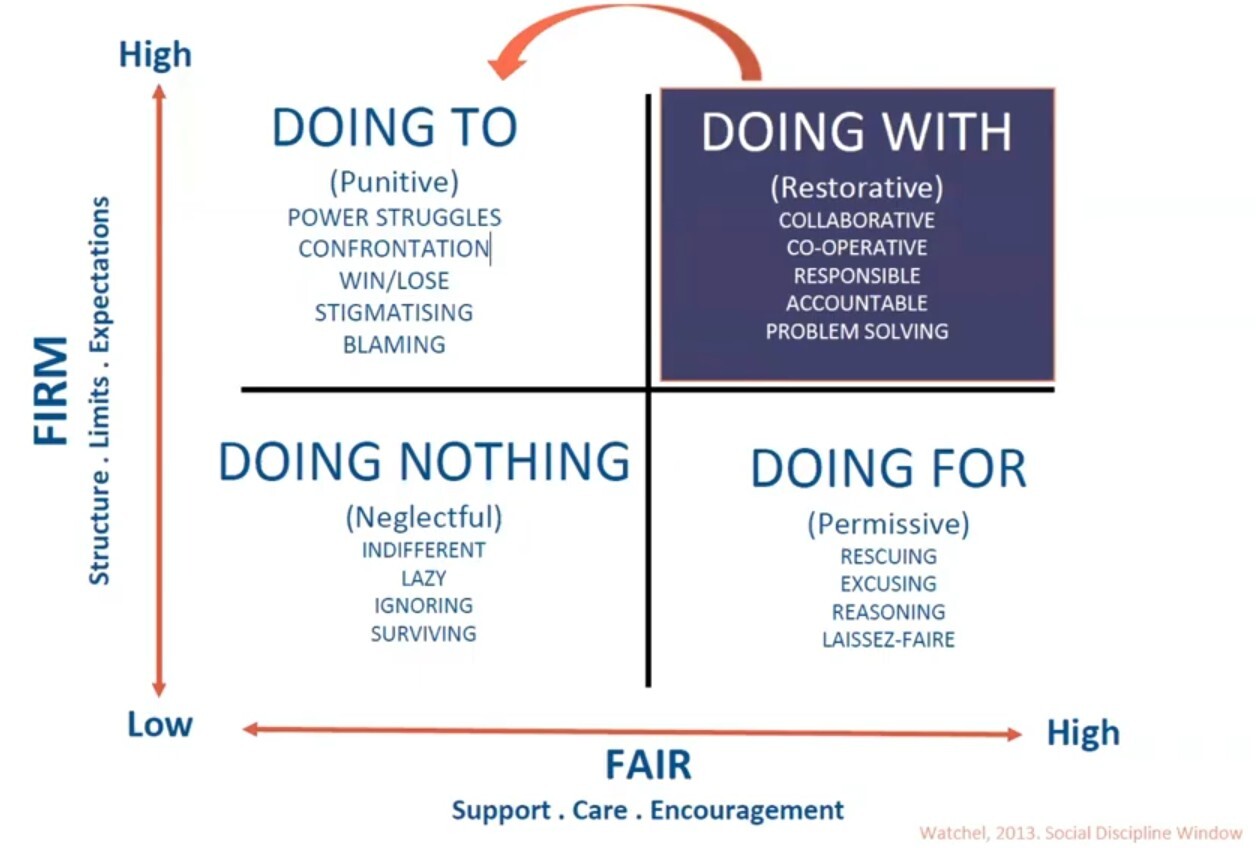
These practices are grounded in the Social Relational Window, combining McCold and Wachtel’s "Social Discipline Window" and Dorothy Vaandering’s "Relationship Window" (Pointer & McGoey, 2026). Students are more cooperative and productive when those in authority do things WITH them (high expectations/accountability balanced with high support) rather than TO them (punitive), FOR them (permissive), or NOT at all (neglectful) (Pointer & McGoey, 2026; Vaandering, 2013).
In a restorative classroom, rules are often co-created by teachers and students rather than imposed. And, whereas traditional models view students as objects to be managed , restorative models treat them as worthy human beings, prioritising high expectations balanced with high support.

Why It Matters: Benefits in Education
Restorative practice provides a transformative alternative to zero-tolerance policies and punitive discipline, one that views conflict as an opportunity for growth and humanisation within the school community. (Lodi et al., 2021). Traditional exclusionary practices such as suspensions and expulsions are often ineffective and linked to poorer long-term outcomes
Research and systematic reviews show that restorative practices lead to:
-
Fewer behavioural issues and greater equity: reduced suspensions, referrals and disciplinary disparities.
-
Enhanced school climate: stronger connectedness and student-teacher relationships.
-
Social-emotional growth: empathy, active listening, accountability and problem-solving.
-
Educator wellbeing: improved staffroom relationships and greater teacher confidence.

A Whole School Approach to Restorative Practices
Presented by Michelle McKersey: Deputy Head of Secondary (Students), Moreton Bay College.
Shifting from rules to relationships and from conflict to connection.
Last updated: 26/07/2026

A Restorative Culture Framework: The Restorative Pyramid
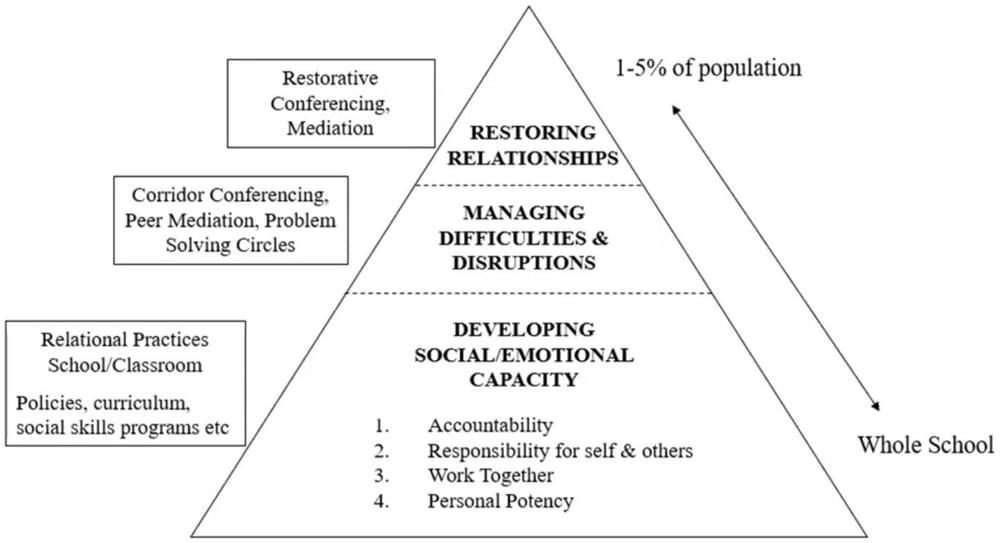
Michelle highlights a framework called the Restorative Pyramid (also described as a triangle model or continuum) used to organise school practices into levels of intervention, moving from universal proactive strategies to intensive formal processes. This model facilitates a systemic shift from punitive "zero-tolerance" discipline toward a relational approach that prioritises trust, belonging, and accountability (Lodi et al., 2021; Moran et al., 2025, Morrison, Blood and Thorsborne, 2005).

The Hierarchy of Restorative Responses or the Restorative Pyramid (Morrison, Blood and Thorsborne, 2005)
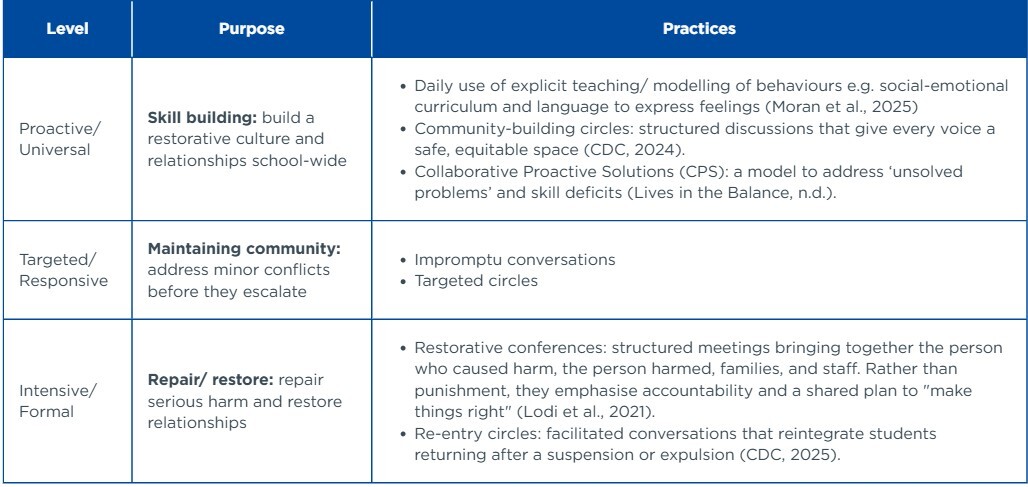
The "pyramid" structure has three levels of practice as shown in the following table:

Collaborative and Proactive Solutions (also known as Collaborative Problem Solving)
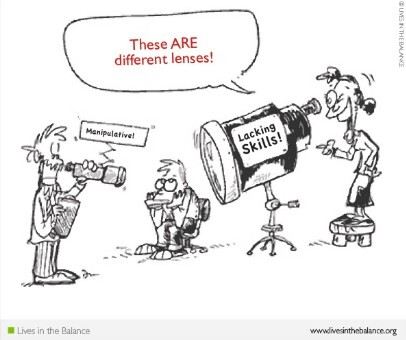
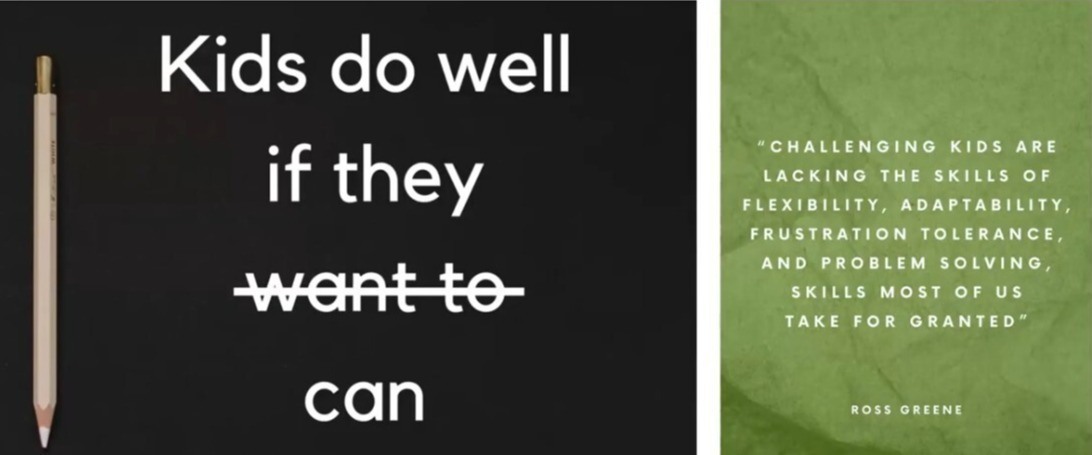
Collaborative and Proactive Solutions (CPS), developed by clinical psychologist Dr Ross Greene, is an evidence-based approach that addresses challenging behaviour by solving its underlying causes rather than controlling the behaviour itself (Lives in the Balance, n.d.). It rests on the belief that "kids do well if they can", challenging behaviour arises when expectations exceed a student's skills in areas such as emotional regulation, frustration tolerance, flexibility, or problem-solving.

CPS is not a behaviour program but a relational, systems-aligned framework requiring leadership commitment, time to collaborate, and alignment across policy, practice, and mindset. Implemented with fidelity, it drives sustainable cultural change rather than short-term compliance. Instead of rewards, punishments, or exclusionary discipline, Michelle outlines three CPS practices:
-
Empathy Step: understand the student's perspective through empathy-based dialogue and identify the unsolved problems triggering the behaviour, e.g. using open-ended questions.
-
Adult Concern Step: the adult states their concerns, such as the impact on the student's learning and on others.
-
Invitation Step: adult and student collaborate to develop solutions addressing both sets of concerns.
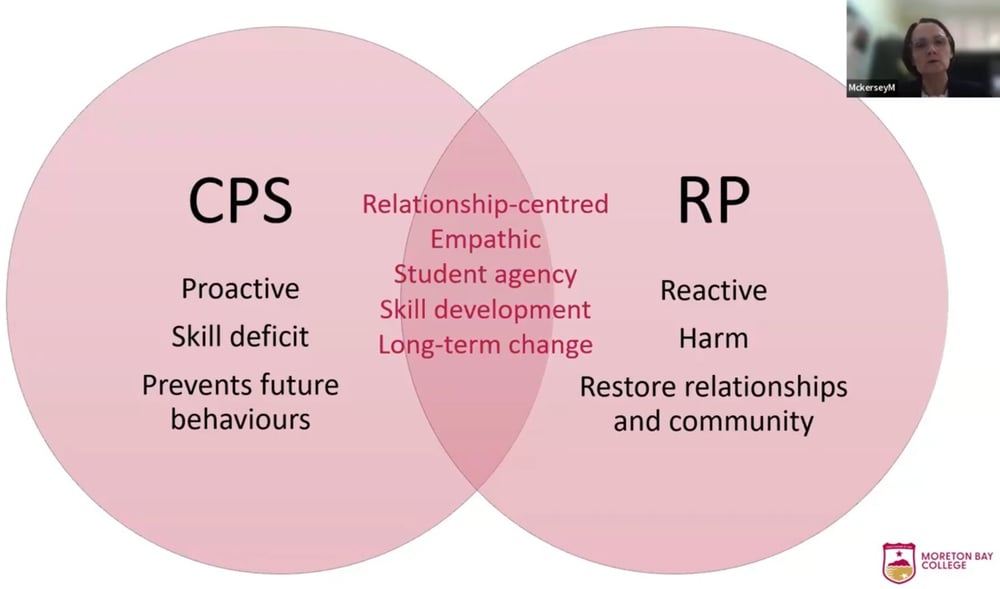
Because the process is collaborative (done with the student) and proactive (addressed before behaviour escalates), it builds skills, trust, and shared responsibility over time. CPS is therefore preventative, unlike restorative practice, which is reactive and applied after harm occurs. Michelle uses a Venn diagram to show these differences alongside the approaches' shared ground: both are relationship-centred, empathic, allow for student agency, and focus on long-term change through skill development.

Collaborative & Proactive Solutions (CPS)
Dr Ross Greene's evidence-based Collaborative & Proactive Solutions model and free hub of training, tools and resources for replacing punitive school discipline with collaborative problem-solving.
Author/Source: Lives in the Balance, Ross Greene.
Last updated: 06/05/2026

Further Resources
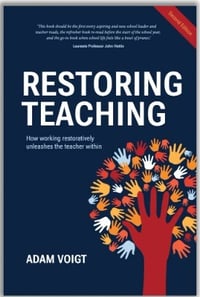
Restoring Teaching (2nd edition) by Adam Voigt
This FREE book is available for free for teachers as an ebook/ aduio book or hardcopy. Building on his Restorative Practice “RP2.0” methodology, this edition includes practical resources and templates for educators developed by Adam, alongside his practical, no-nonsense advice to help you implement restoratives practice in your classroom.

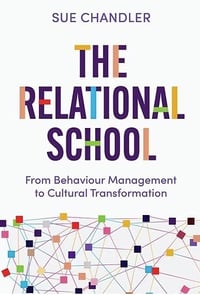
The Relational School by Sue Chandler
The Relational School examines why schools’ relational values often fail to translate into daily practice, and how systems can unintentionally undermine connection. It offers a practical, systems-level framework and tools to help leaders intentionally design school cultures grounded in trust, clarity, and shared responsibility.

Building a stronger school community through Restorative Practice: a case study (Reimer, K. 2024)
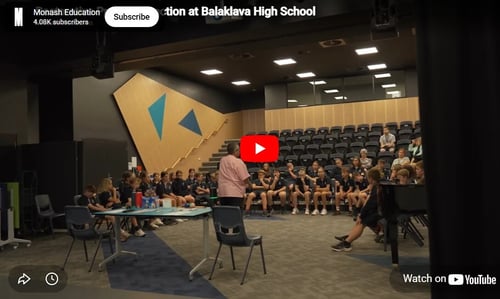
Watch a short video by Monash University of the impact of restorative practice at Balaklava High School in South Australia. Through intentional and thoughtful implementation, the school saw a reduction in expulsions and incidents of violence, including a change in staff attitudes and a positive impact on the community.

Additional Reading
-
An overview of Collaborative and Proactive Solutions (Rosen, B., 2020): A research-informed reference situating CPS within the wider field of therapeutic and behavioural interventions—useful for researchers, clinicians, and practitioners.
-
The Australian Context: Restorative Practices as a Platform for Cultural Change in Schools (Blood, P., 2005): Argues that Restorative Practices work best as a whole-school cultural shift rather than a behaviour management tool, with sustainable change requiring relational thinking, proactive skill-building, and aligned beliefs, practices, and structures. Includes the Restorative Pyramid.
-
Exploring restorative practices: Teachers' experiences with early adolescents (Moran, E., Sloan, S., Walsh, E. & Taylor, L., 2024): A qualitative study of nine Irish primary school leaders, finding that building a restorative culture is a long-term, transformative shift in values that enhances student autonomy and school harmony.
-
Understanding the social relational window (Pointer, L. & McGoey, K., 2026): Presents the Social Relational Window as a model for understanding how a restorative approach differs from others.
-
In Pursuit of Paradigm: A Theory of Restorative Justice (McCold, P. & Wachtel, T., 2003): Introduces the Social Discipline Window and the case for restorative justice in repairing harm.
-
Promoting healthy school communities through restorative practices (Centers for Disease Control and Prevention, 2024): An infographic overview of restorative practices, their benefits, and further resources.
Related Resources
2026 PD Wrap Up: Connection IS The Content: A Pathway to Wellbeing
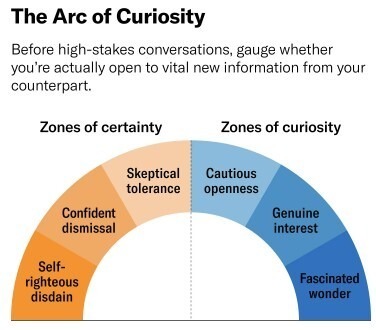
Curiosity Check and the Ask Approach

Communicating with Today's Parents: McCrindle Research and RoundTable

Connection IS The Content: A Pathway to Wellbeing

2026 PD Wrap Up: The Space Between Knowing and Doing

The Space Between Knowing and Doing
A Whole School Approach to Restorative Practices
2026 PD Wrap Up: A Whole School Approach to Restorative Practices
Creating a Wellbeing Environment: Positive Leadership Practices
2026 PD Wrap Up: Connection IS The Content: A Pathway to Wellbeing
Curiosity Check and the Ask Approach
Communicating with Today's Parents: McCrindle Research and RoundTable
Connection IS The Content: A Pathway to Wellbeing
2026 PD Wrap Up: The Space Between Knowing and Doing
The Space Between Knowing and Doing
A Whole School Approach to Restorative Practices
2026 PD Wrap Up: A Whole School Approach to Restorative Practices