2026 PD Wrap Up: Co-designing a Student-Led Wellbeing Conference in the Middle Years
Building on our Term 1 focus of cultivating a thriving community from day one, we welcomed Edward McInnes, Year 7 Wellbeing Leader at Scotch College, to hear about the pivotal role of student agency during the Middle Years. The session explored how fostering student agency empowers learners to move beyond passive participation, allowing them to actively shape their own experiences and contribute meaningfully to their school culture.
Ed shared Scotch College’s innovative "Wellbeing Scientists" model, where students lead their own inquiry into personal and collective wellbeing. A standout highlight was their student-led Wellbeing Conference, a co-designed event where students present research and facilitate workshops for peers and families. By stepping into conference roles, students are empowered to take wellbeing from a classroom concept into a visible, lived practice that resonates across the entire school community.
Author/Source: PESA and Ed McInnes, Scotch College.
Last updated: 09/03/2026

Why the Middle Years?
The middle years represent a "second window" of neurological development nearly as significant as the first five years of life. This period of rapid biological and cognitive "overhaul" is a critical transition point where the foundations for adulthood are solidified. Because students are navigating the dual pressures of puberty and the shift to secondary schooling, their sense of wellbeing during these years becomes a primary determinant of their long-term academic engagement and social mobility.
According to research (Redmond, et. al., 2016), several factors make this life stage uniquely significant:
-
Biological "Overhaul": Rapid brain and hormonal changes make this a peak period for cognitive shifts, which can create significant stress and feelings of insecurity.
-
Major Life Transitions: The shift to secondary school is a high-risk point for disengagement and academic decline.
-
Long-term Impact on Adulthood: Wellbeing during these years is a primary determinant of a student's future health, social engagement, and adult success.
-
Opportunity for Equity: Targeted support ensures that family circumstances or background do not unfairly dictate a young person's future achievements.
For educators, this stage is a powerful opportunity to make a real difference. Focusing on student agency and wellbeing during this key development period helps tackle pressures like schoolwork stress or social exclusion before they become ongoing challenges. By supporting students in these years, we give them the tools and confidence to shape a meaningful life well beyond the classroom.
Speaking the Same Language: Why Definition Matters
Wellbeing is a term we use daily in education, yet it remains notoriously “conceptually muddy." Because it is so multifaceted, schools often struggle to translate idea into effective practices. Without a precise definition there is risk of inconsistency, where a student’s experience depends entirely on which teacher they happen to have (Barry et al., 2017).
To move toward a true whole-school approach to wellbeing, a commitment from every stakeholder is needed. Without that shared clarity, it is difficult to navigate the sea of available programs and find a consensus on what actually onstitutes best practice (Svane et al., 2019).
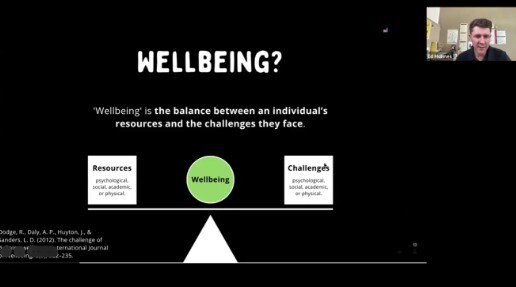
In the webinar, Ed shared Scotch Colleges definition for wellbeing, which was informed by the research paper, The challenge of defining wellbeing (Rachel Dodge · Annette P. Daly · Jan Huyton · Lalage D. Sanders, 2012). This definition comes with clear visuals that wonderfully illustrate the need to balance resources and challenges to optimise psychological, social, academic and physical wellbeing.

Here are five reasons why establishing a common language for wellbeing is essential for school communities:
1. Facilitating Fair and Valid Measurement
Defining wellbeing makes tracking progress tangible. It allows us to use quantitative tools to monitor student needs accurately and ensure assessments are fair and valid (Dodge, et. al., 2012).
2. Creating a Common Language
A clear definition serves as the foundation for a holistic framework. It gives teachers, students, and parents a shared vocabulary to use across academic, social, and co-curricular contexts. When we all speak the same language, we can reinforce wellbeing messages in everyday moments, in every classroom. (Scholz et. al., 2024).
3. Guiding Policy and Fiscal Responsibility
A clear definition helps leaders choose evidence-based programs that work, rather than popular, stand-alone initiatives that yield inconsistent results. This ensures schools are fiscally prudent. (Laurens et al., 2022).
4. Moving Toward Positive Functioning
A precise definition helps us shift away from a deficit view (where wellbeing is merely the absence of illness) and toward a perspective of flourishing. For adolescents, this means focusing on connection, relationships, and understanding their own values.
5. Tailoring to Context
While a robust definition provides a universal framework, it also allows us to nuance our approach. Every student has a unique resource pool and faces different challenges. By defining our goals clearly, we move away from “one-size-fits-all” strategies that are often unrealistic and ineffective. (Scholz et. al., 2024).
Co-designing a Student-Led Wellbeing Conference in the Middle Years
Presented by Ed McInnes: Wellbeing Leader-Year 7, Scotch College, Adelaide.
Empowering middle years students to research, lead, and share wellbeing with their community.
Last updated: 09/03/2026

Practical Resources
Ed kindly shared the follolwing resources to assist in encouraging student participation and reflection, workshop design materials and event run sheets.
Scotch College Blueprint
This guide synthesises insights shared by Ed McInnes in PESA’s Digital PD, ‘Inspiring Change: Co-Designing a Student-Led Wellbeing Conference in the Middle Years’, providing a scalable model for educators to transition from classroom-based wellbeing theory to a student-led culminating event tailored to their own unique school context.
Ripple Reflection Chart
This worksheet supports students to recognise the broader impact of their behaviour on the school community, visualised as ripples created by a drop in water (see 31:51 of the webinar).
Workshop Design, Poster and Run Sheet Materials
Scotch College Blueprint
This guide synthesises insights shared by Ed McInnes in PESA’s Digital PD, ‘Inspiring Change: Co-Designing a Student-Led Wellbeing Conference in the Middle Years’, providing a scalable model for educators to transition from classroom-based wellbeing theory to a student-led culminating event tailored to their own unique school context.
Ripple Reflection Chart
This worksheet supports students to recognise the broader impact of their behaviour on the school community, visualised as ripples created by a drop in water (see 31:51 of the webinar).
Workshop Design, Poster and Run Sheet Materials
Referenced Research and Reports
-
Are the kids alright? Young Australians in their middle years: Final report of the Australian Child Wellbeing Project (Redmond et.al., 2016): Drawing on a national survey of over 5,400 students, the Australian Child Wellbeing Project (ACWP) provides a comprehensive analysis of how young people aged 8–14 perceive their own wellbeing.
-
Promoting social and emotional well-being in schools (Barry, M. M., Clarke, A. M., & Dowling, K., 2017): This paper explores a "common elements" approach to social and emotional learning, aiming to bridge the gap between theory and classroom reality by identifying universal, evidence-based strategies that can be sustainably embedded into everyday school systems.
-
The challenge of defining wellbeing (Rachel Dodge · Annette P. Daly · Jan Huyton · Lalage D. Sanders, 2012): This paper reviews historical and modern theories of wellbeing to propose a new, universal definition centred on a "state of equilibrium" that is dynamically maintained as individuals navigate life's challenges and transitions.
-
An exploration of the efficacy of mental health and wellbeing education initiatives in secondary schools: triangulation of student and teacher perspectives An exploration of the efficacy of mental health and wellbeing education initiatives in secondary schools: triangulation of student and teacher perspectives (Scholz, et. al., 2024): This study highlights a disconnect between school investment and student impact, emphasising that effective wellbeing education requires specialised staff training and a shift toward nuanced, school-wide frameworks that prioritise interpersonal connection over standalone programs.
-
School-based mental health promotion and early intervention programs in New South Wales, Australia: Mapping practice to policy and evidence. (Laurens, et.al., 2022): This study of 597 NSW primary schools reveals a significant gap between program implementation and actual effectiveness, finding that while most schools deliver wellbeing initiatives, many lack a strong evidence base or measurable impact.
Related Resources
Curiosity Check and the Ask Approach
A Whole School Approach to Restorative Practices
2026 PD Wrap Up: A Whole School Approach to Restorative Practices
Harnessing Collective Action to Sustain Wellbeing Initiatives in Learning Communities

2026 PD Wrap Up: Harnessing Collective Action to Sustain Wellbeing Initiatives in Learning Communities
Co-designing a Student-Led Wellbeing Conference in the Middle Years
2026 PD Wrap Up: Co-designing a Student-Led Wellbeing Conference in the Middle Years

The Scotch College Blueprint for developing a student-led wellbeing conference

Ripple Reflection Chart
Curiosity Check and the Ask Approach
A Whole School Approach to Restorative Practices
2026 PD Wrap Up: A Whole School Approach to Restorative Practices
Harnessing Collective Action to Sustain Wellbeing Initiatives in Learning Communities
2026 PD Wrap Up: Harnessing Collective Action to Sustain Wellbeing Initiatives in Learning Communities
Co-designing a Student-Led Wellbeing Conference in the Middle Years
2026 PD Wrap Up: Co-designing a Student-Led Wellbeing Conference in the Middle Years
The Scotch College Blueprint for developing a student-led wellbeing conference