2026 PD Wrap Up: The Perimenopausal Brain at Work
Perimenopause is quietly shaping the lives of many women working in education right now, yet the conversation around it remains largely focused on the physical. The psychological dimension: the cognitive shifts, the identity questions, the relational changes, has largely gone unaddressed.
The 2026 term 2 professional learning webinar, "The Perimenopausal Brain at Work" set out to change that. Grounded in neuroscience, positive psychology, and the practical realities of working in schools, the session explored three interconnected areas: what is actually happening in the perimenopausal brain, the relational and 'noisy' changes that flow from it, and what the research tells us about navigating this transition well.
Read on for a summary of the key takeaways, opportunities to reflect on your own experiences and practical resources.
Author/Source: PESA and Nicole Border and Berni Cooper of Fluxx.
Last updated: 17/06/2026

Why perimenopause belongs in the wellbeing conversation
At PESA, our learning focus for Term 1, 2026 is simple yet impactful: putting people at the centre of everything we do. Reconnecting staff, students, and families is the foundation of a vibrant, inclusive community, and it begins with the understanding that staff wellbeing is the bedrock of a healthy learning environment.
We were recently joined by Justin Robinson, Director and Co-Founder of The Wellbeing Distillery, for an online masterclass on ‘Building a Shared Responsibility for Teacher Wellbeing’, where he shared the Wellbeing Quadrant, a practical framework designed to promote wellbeing and proactively prevent ill-being. Below, we have synthesised the key takeaways and curated resources to support your school’s action planning for staff wellbeing.
Perimenopause is having a cultural moment including Senate inquiries, government campaigns, social media conversations. But as Berni and Nicole noted, most of that conversation centres on the physical: hormone replacement therapy (HRT), protein, exercise, sleep. The psychological dimension such as the cognitive shifts, identity questions, and relational changes remains largely unaddressed.
This matters enormously for the education sector:
• 53% of Australian teachers are aged 40–59: squarely within the perimenopausal age range
• 83% of women experiencing perimenopause report impacts at work (Circle In, 2021)
Perimenopause is the transitional period leading up to menopause, typically lasting 4 to 10 years, occurring roughly between the ages of 35 and 55. Menopause itself is a single moment in time (12 months since a woman’s last period), while postmenopause encompasses the years that follow, which, for many women, represents up to a third of their lives.
An important distinction the presenters made: perimenopause is biological, but midlife is contextual. For educators, the collision of internal hormonal change with external pressures such as demanding workloads, caring responsibilities, career transitions, and financial pressure creates what Berni described as a “perfect storm.” Understanding what is biological helps separate it from what is contextual, which matters enormously for how women (and those around them) interpret what they are experiencing.
Inside the perimenopausal brain
The presenters drew on the work of neuroscientist Lisa Mosconi, who identifies three stages in a woman’s life where the brain undergoes major hormonal transitions: puberty, pregnancy, and perimenopause. All three produce remarkably similar changes in body temperature, mood, sleep, memory, brain energy, and connectivity. Yet while puberty and pregnancy are framed as preparing the brain for a new phase of life, perimenopause has largely been framed as decline.
During perimenopause, four brain regions recalibrate:
-
The hippocampus (memory): fluctuating oestrogen interrupts memory consolidation, causing word-finding difficulties and forgetfulness. Importantly, objective measures of cognitive erformance show only small, temporary dips but the internal distress often feels worse than it appears externally.
-
The amygdala (emotions): becomes increasingly volatile as it recalibrates, producing mood swings, emotional reactivity, and heightened sensitivity.
-
The hypothalamus (temperature regulation): as it recalibrates to lower oestrogen levels, it misreads the body’s temperature, triggering hot flushes.
-
The prefrontal cortex (problem-solving and judgement): temporarily affected during the transition, contributing to difficulties with complex decision-making and pattern recognition.
The presenters used a memorable set of orca characters to illustrate how these changes show up in daily life. As you read through them, take a moment to reflect on which one/s you have often felt:
-
the Overwhelmed Orca: carrying everything and everyone
-
the Invisible Orca: feeling unseen and unheard
-
the Lost Orca: questioning identity and direction
-
the Depleted Orca: exhausted but pushing on
-
the Brain Fog Orca: losing words mid-sentence and
-
the Emotionally Volatile Orca: cycling rapidly through emotions.
For many educators in the room, more than one resonated. As one participant put it: "Which do I not identify with?"
“When communication is part of your identity, as it is for teachers, when your voice is your work, a loss of words doesn’t just feel like an inconvenient gap. It feels like you’re losing the version of yourself that’s doing this job.”
- Berni Cooper
The Perimenopausal Brain at Work
Presented by Berni Cooper and Nicole Border of Fluxx.
Understanding cognitive, emotional and relational shifts during the perimenopausal phase of life, and why they matter in schools.
Last updated: 17/06/2026
An alternative narrative: transition, not decline
One of the most powerful reframes in the session came from evolutionary biology. Humans are one of only a handful of species to have evolved post-reproductive females, precisely because of the advantages they provide. In orca pods, post-menopausal females become the most critical members: they carry decades of ecological knowledge, know where to find food in scarce seasons, and navigate safe routes. Pods led by elder females have significantly higher survival rates. This is the ‘grandmother hypothesis’ and it offers a profoundly different story about what perimenopause is preparing women for.
The brain changes of perimenopause also carry genuine gifts. As the transition progresses, the prefrontal cortex takes on a larger role. Crystallised intelligence increases drawing on decades of experience to recognise complex patterns and solve problems with greater ease. The amygdala becomes less reactive to negative emotions. Boundaries strengthen. Empathy deepens without the overwhelm that once accompanied it. Research consistently shows that post-menopausal women report greater happiness, better mental health, and increased contentment with life.
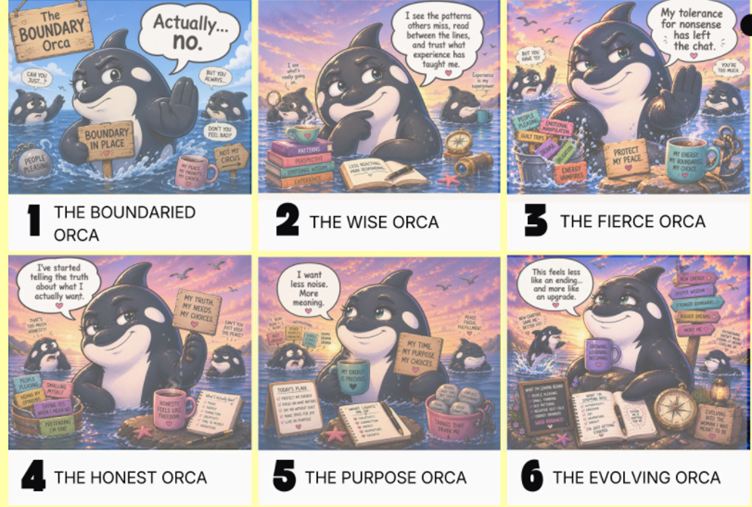
The presenters introduced a corresponding set of ‘positive orcas’ to illustrate this shift: the Boundaried Orca, the Wise Orca, the Fierce Orca, the Honest Orca, the Purpose Orca, and the Evolving Orca. As one participant put it: “This feels less like an ending… and more like an upgrade.”

Six positive orcas representing the ‘gifts’ of hormonal changes during perimenopause, FLUXX.
Did you know:
the Japanese word for perimenopause is ‘konenki’ (koh-nen-kee) which literally translates as "season of renewal" or "renewal years”.
Relational and ‘noisy’ changes
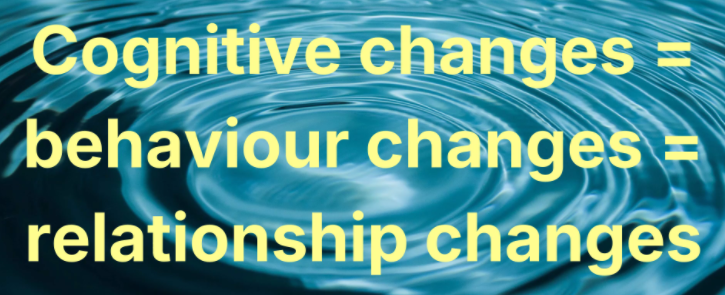
Cognitive changes don’t stay internal, they ripple outward. For educators, whose work is deeply relational, this matters enormously.

During perimenopause, many women become less willing to overfunction - to carry everyone else's needs before their own. They step back from extra committees, stop after-hours emails, decline requests they would once have automatically taken on. This is not a loss of care. It is a redistribution of finite cognitive and emotional resources.
When someone who has always said yes begins to say no, those around her often push harder before they adjust. Behavioural science calls this an extinction burst. Frustration and comments like "but you always help out" are not evidence the boundary is wrong. They are evidence the system is adjusting. Teachers will recognise the dynamic from their own classrooms: it is the student who escalates before finally settling into a new expectation.
Improving wellbeing during this transition: what the research tells us
Berni and Nic distilled the evidence into three key levers that meaningfully improve wellbeing during perimenopause:
1. Understanding
Women who feel informed, hopeful, and prepared report better wellbeing and less distress during the transition (Godfrey & Bogg, 2025; Ayers, Forshaw & Hunter, 2010). Critically, the earlier this understanding comes, ideally before symptoms begin, the more protective it is.
2. Compassion
Women who are kinder to themselves during perimenopause experience greater wellbeing and resilience, regardless of symptom severity (Brown et al., 2015). Equally, empathy, flexibility, and understanding from others significantly influences how supported women feel. The culture of a staffroom, how leaders and colleagues respond to visible signs of struggle, matters more than many realise.
3. Boundaries
Research suggests that healthy boundaries serve as a protective mechanism during perimenopause, preserving finite cognitive and emotional resources, reducing overload, and creating space to reassess priorities and identity during the transition (Meng et al., 2025).
How educational leaders can support women through perimenopause
Understanding perimenopause is not just a personal matter, it is a leadership responsibility. With over half the teaching workforce in the perimenopausal age range, leaders who are informed, compassionate, and flexible can make a significant difference to the wellbeing and retention of their most experienced staff.
1. Educate yourself. Understand that cognitive and emotional changes during perimenopause are neurological, not personal failings or performance issues. Memory lapses, emotional volatility, and word-finding difficulties are real, temporary, and not a reflection of capability or commitment.
2. Create psychological safety. Enable women to speak openly about what they are experiencing, without fear of judgement or performance implications. A school culture where this can be named, not just whispered, is protective.
3. Honour the shift in boundaries. When an experienced colleague begins saying no to tasks she previously carried, resist interpreting this as disengagement. It is likely a sign of someone protecting finite cognitive resources and transitioning into a healthier, more sustainable way of working.
Understanding perimenopause is not just a personal matter, it is a leadership responsibility.
4. Protect genuine break time. Educators are not taking real breaks during the school day. For women in perimenopause, uninterrupted rest and recovery is not optional, it is part of managing the cognitive and emotional load the role demands.
5. Respond with flexibility and understanding. Review workload sustainability and the scheduling of cognitively demanding tasks. Consider physical environment factors such as temperature control and access to quiet spaces. Small adjustments can significantly reduce the daily burden.
6. Normalise the conversation. Consider professional learning that builds shared understanding across the whole staff community, not only for those currently experiencing perimenopause. The research is clear: women who are informed earlier have better outcomes. Sessions like this webinar are a good starting point.
7. Use a compassionate tone. The way perimenopause is spoken about in your school community matters. When a colleague loses her train of thought in a meeting, when she seems uncharacteristically emotional, or when she steps back from things she once led, respond with curiosity and kindness before drawing conclusions. A culture where women feel seen and supported during this transition is built in the small moments, not just in policy.
Readings and Practical Resources
From Fluxx
Additional Research and Readings
A curated reading list from FLUXX covering the research, books, podcasts, and videos that informed the webinar. The list spans neuroscience, positive psychology, and wellbeing science with something for every level of interest, from short accessible videos to deeper reads.
The Fluxx Midlife Pulse Tool
A free self-reflection tool that maps wellbeing across five dimensions of midlife: Seeing Midlife Differently, Working with Your Emotions, Knowing Yourself, Feeling Connected, and Handling What Comes.
Learn more about whether you’re feeling resourced, building capacity, or still finding your feet in each area.
Additional Research and Readings
A curated reading list from FLUXX covering the research, books, podcasts, and videos that informed the webinar. The list spans neuroscience, positive psychology, and wellbeing science with something for every level of interest, from short accessible videos to deeper reads.
The Fluxx Midlife Pulse Tool
A free self-reflection tool that maps wellbeing across five dimensions of midlife: Seeing Midlife Differently, Working with Your Emotions, Knowing Yourself, Feeling Connected, and Handling What Comes.
Learn more about whether you’re feeling resourced, building capacity, or still finding your feet in each area.
Related Resources
2026 PD Wrap Up: Connection IS The Content: A Pathway to Wellbeing
Curiosity Check and the Ask Approach

Communicating with Today's Parents: McCrindle Research and RoundTable

Connection IS The Content: A Pathway to Wellbeing

2026 PD Wrap Up: The Space Between Knowing and Doing

The Space Between Knowing and Doing

A Whole School Approach to Restorative Practices
2026 PD Wrap Up: A Whole School Approach to Restorative Practices
Creating a Wellbeing Environment: Positive Leadership Practices
2026 PD Wrap Up: Connection IS The Content: A Pathway to Wellbeing
Curiosity Check and the Ask Approach
Communicating with Today's Parents: McCrindle Research and RoundTable
Connection IS The Content: A Pathway to Wellbeing
2026 PD Wrap Up: The Space Between Knowing and Doing
The Space Between Knowing and Doing
A Whole School Approach to Restorative Practices
2026 PD Wrap Up: A Whole School Approach to Restorative Practices