Optimism, Hope and Goals
“A rainbow is a prism that sends shards of multicolored light in various directions. It lifts our spirits and makes us think of what is possible. Hope is the same – a personal rainbow of the mind.”
- C. R. Snyder
Author: PESA with contributions from Dr Rachel Colla
Last updated: 13/05/2026

Positive psychology identifies optimism, hope, and goal-setting as interconnected psychological resources that support wellbeing, motivation, and achievement in educational settings. While closely related, each construct plays a distinct role in shaping how students, educators, and schools anticipate the future, respond to challenge, and sustain effort over time.
Research in positive psychology demonstrates that these constructs are malleable, meaning that intentional interventions and daily practices can strengthen them (Seligman, 1998; Marques et al., 2011).
These constructs differ but are related:
-
Optimism reflects positive expectations about the future (mindset)
-
Hope provides the motivation and pathways for goal attainment
-
Goal-setting translates belief and agency into action through specific targets to guide effort and persistence.
Optimism
In positive psychology, optimism is defined as a general expectation that good things will happen in the future, together with a tendency to explain difficulties as temporary, specific, and changeable, rather than permanent, pervasive, or personal (Carver & Scheier, 2014; Seligman, 1998).
Optimism is not denial of difficulty. It reflects a realistic, future-oriented mindset that influences persistence, coping, and engagement.
Explanatory (Learned) Optimism
Understanding explanatory styles is crucial for educators because these styles represent the underlying cognitive habits that determine whether a student defaults to an optimistic or pessimistic outlook, especially in the face of adversity. This internal narrative shapes how students interpret their successes and failures, which in turn influences their motivation, persistence, and overall wellbeing. An "optimistic explanatory style," as detailed in the work of Martin Seligman (1998) is characterised by the belief that setbacks and negative events are not permanent or pervasive. An optimist tends to interpret negative events according to three core beliefs:
1. Temporary: They view bad situations as transient and not permanent fixtures of their lives. A poor grade on a test is seen as a one-time event, not an unchangeable sign of failure.
2. Not Personal: They acknowledge that negative situations are usually not entirely their own fault. While taking responsibility for their actions, they can see the influence of external factors or circumstances.
3. Specific: They believe that a bad situation is confined to one area and does not necessarily affect all aspects of their life. Failing a math test doesn't mean they are a failure in all subjects or in their social life.
Hope
Hope is defined as wanting something good to happen, believing it is possible, and trusting that you have the skills or help needed to reach that outcome (Greater Good in Education, 2025). Hope, as conceptualised in Snyder’s (2002) Hope Theory, is an active (doing) process for an individual, defining:
-
Goals: These are the targets of mental action sequences and serve as the anchors for the hope process, providing direction and purpose.
-
Pathways: An individual's perceived ability to generate numerous and flexible routes towards their goals
-
Agency: Goal-directed energy and determination to use those pathways in the pursuit of goals
For example, a student who aspires to improve their performance in a topic in math shows agency thinking by believing in their ability to improve and determination to use pathway thinking by seeking alternative strategies, such as watching videos or engaging with artificial intelligence or a tutor to further explain the topic.
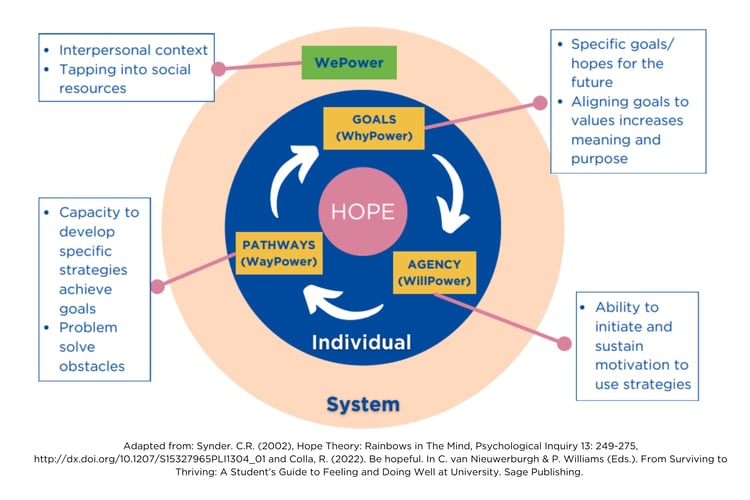
As shown in the following diagram, Colla et al. (2022) propose an extension of this theory that incorporates a systems view and acknowledges the interplay between the human system and social systems. This broader view suggests that hope is not simply an individual resource developed through thinking processes but rather emerges from the dynamic interplay between thoughts, feelings, behaviours, and social interactions. A systems perspective acknowledges that hope is sustained by both internal and external resources, such as community support, common values, and even a belief in the world’s goodness, fairness, and beauty. Furthermore, this view recognises that systemic inequalities and cultural backgrounds significantly influence what an individual hopes for and their perceived ability to turn those hopes into reality.

A systems model of hope consists of:
-
WhyPower: pursuing a meaningful and valuable aspirations
-
WayPower: identifying adaptive pathways towards a desired future
-
WillPower: sustaining motivation and energy
-
WePower: engaging social resources to fuel motivation and pathways planning
In Snyder’s psychological theory, hope cannot exist without goals. Hope is centred on goal pursuit and having clear and specific targets for what you want to achieve (Marques & Lopez, 2014). Because of this, goal-setting is seen as the active process that puts hope into motion (Greater Good in Education, 2025). Students with high hope set more ambitious goals and are more likely to find ways to make them a reality (Thinking Habitats, 2025).
Why optimism and hope matter in education
Optimism and hope are closely related but distinct psychological constructs, and together they play a powerful role in education. In educational settings, optimism provides the psychological climate that fosters motivation, persistence, and resilience, while hope translates this mindset into strategic action, enabling learners to plan, problem-solve, and persist in the face of academic or social challenges (Putwain et al., 2018; Seligman et al., 2009). Together, these constructs support engagement, self-regulation, adaptive coping, and ultimately contribute to both student achievement and educator wellbeing (Hoy et al., 2006; Goddard et al., 2015).
Optimism provides a foundational belief that supports the development of hope, offering a general “bright side” perspective that motivates people to set goals in the first place (Greater Good in Education, 2025; Noble & McGrath, 2014). Individuals with an optimistic explanatory style tend to interpret setbacks as temporary and specific, rather than permanent or pervasive, which allows them to maintain hope and continue striving toward their goals even after failure (Noble & McGrath, 2014; Marques & Lopez, 2014). While optimism reflects a broad expectation that things will work out, hope is more action-oriented, focusing on personal agency and the belief that one has the power to influence outcomes and create a better future (Thinking Habitats, 2025).
Hope and optimism are essential predictors of student success, with high hope levels correlating significantly with better grades, increased credits earned, and higher school attendance (Marques et al., 2017; Thinking Habitats, 2025; Wong & Cheung, 2024). These mindsets serve as a protective buffer against anxiety, stress, and burnout, particularly during high-pressure transitions such as the start of high school (Greater Good in Education, 2025; Thinking Habitats, 2025). By adopting an optimistic explanatory style, students learn to view setbacks as temporary and specific rather than permanent personal failings, which builds the resilience necessary to keep goals in play and persist toward long-term objectives (Kearns, 2017; Nemours KidsHealth, 2026; Seligman, 1998). Furthermore, hopeful students report a stronger sense of belonging and more positive social interactions, as their demeanor tends to attract friendships and foster perceived support from both teachers and peers (Greater Good in Education, 2025; Marques & Lopez, 2014).
Practical strategies to foster optimism and hope in education
-
Visualising a Positive Future: Exercises like imagining a "Best Possible Self" (BPS) help students envision achieving their goals, strengthening agency, pathways thinking, and optimistic thinking, while activating intrinsic motivation and building resilience (Snyder, 2002; Fredrickson, 2001).
-
Values Exploration: Exercises that allow students to explore their values to assist them to unlock motivation and energy for action (Colla, 2022).
-
Gratitude Journaling: Recording "Three Good Things" or daily gratitudes shifts focus toward positive experiences and fosters optimism (Chowdhury, 2019)
-
Hope Mapping: Setting specific, measurable goals and identifying multiple pathways enhances agency and persistence. Educators can model hopeful thinking by framing setbacks as opportunities to try alternative strategies (Snyder, 2002; Thinking Habitats, 2025.).
-
Disputing Negative Thoughts: Techniques like the ABCDE model help reframe adversity as temporary and manageable, supporting resilience and optimistic thinking (Chowdhury, 2019; Seligman, 1998).
-
Future-Focused Language: Using future-oriented language e.g. “When you master this skill…” promotes self-efficacy, hope, and positive expectations (Marques & Lopez, 2014; Thinking Habitats, 2025)
-
Curriculum Integration: Teachers can infuse hope into subjects like history or literature by having students analyze the goals, obstacles, and energy of resilient historical figures or characters (Marques & Lopez, 2014).
Integrating these practices into daily routines, through goal reflection, gratitude, and strength acknowledgment, helps cultivate optimism and hope in students while modelling constructive, future-focused thinking for the school community (Seligman, 1998).
Considerations
Fostering optimism is a valuable, evidence-based goal in education, but it must be applied with care, particularly within trauma-aware contexts. For some students, especially those with lived experiences of adversity, uncritical or enforced positivity can feel invalidating and may undermine emotional safety. Certain cognitive tendencies that appear positive can, if left unexamined, undermine student wellbeing. One key example is optimism bias: the belief that challenges will resolve on their own or that negative outcomes are more likely to affect others. This bias can discourage help-seeking, lead students to downplay stress, and delay support until difficulties escalate (Stanley-Clarke et al., 2024).
A trauma-aware approach recognises that optimism is most effective when it is realistic, flexible, and grounded in agency. Educators play an important role in helping students develop optimism as a thinking skill, one that sits alongside self-awareness, emotional validation, and choice (Brunzell, 2021).
Educators can reduce these risks by:
-
Explicitly teaching students about optimism bias and its impact on decision-making.
-
Normalising challenge and emotional responses before inviting cognitive reframing.
-
Using peer-to-peer approaches to mental health and wellbeing messaging, as students are often more responsive to examples from peers who have sought and benefited from support (Stanley-Clarke et al., 2024).
When optimism is balanced with self-awareness, hope, and purposeful goal-setting and offered within a framework of safety, choice, and realism, it becomes a practical tool rather than a blind belief. Applied thoughtfully, these constructs support resilience, help-seeking, and a thriving school community.
Research and Frameworks
Hope Theory (Snyder, 2002): Hope is defined as goal-directed thinking comprising agency and pathways:
-
hope = agency + pathways
-
agency (belief in one’s ability to achieve goals)
-
pathways (ability to identify routes to achieve those goals).
Optimism and Future Orientation:
-
Dispositional optimism (Carver & Scheier, 2014): refers to a relatively stable tendency to expect positive outcomes over time. Research by Charles Carver and Michael Scheier links optimism to sustained effort, adaptive coping, and improved psychological wellbeing.
-
Learned Optimism (Seligman, 1998): focuses on the cognitive habits, or "explanatory styles," people use to interpret life events. The theory posits that individuals can learn to adopt a more optimistic explanatory style, viewing negative events as temporary, specific, and not entirely personal which builds resilience and protects against feelings of helplessness.
Goal-Setting and Motivation:
-
Goal-Setting Theory (Locke & Latham, 1990): specific, challenging, and attainable goals drive higher performance than vague or easy goals. Goals focus attention, mobilize effort, increase persistence, and promote strategy development.
-
Self-Determination Theory (SDT) (Ryan & Deci, 2000): highlights that motivation is strongest when students experience autonomy, competence, and relatedness (Ryan & Deci, 2000); hope enhances this framework by providing agency and pathways thinking, empowering students to identify actionable strategies to achieve meaningful goals.
-
Broaden-and-Build Theory (Fredrickson, 2001): Optimistic and hopeful learners are more likely to explore multiple strategies, persist in the face of difficulty, and build cognitive, social, and emotional resources that support long-term achievement and resilience, illustrating the dynamic feedback loop Fredrickson describes between positive emotions and resource development.
References
Brunzell, T. (2021). Trauma-Aware Practice and Positive Education. In: Kern, M.L., Wehmeyer, M.L. (eds) The Palgrave Handbook of Positive Education. Palgrave Macmillan, Cham. https://doi.org/10.1007/978-3-030-64537-3_8
Colla, R. (2022). Be hopeful. In C. van Nieuwerburgh & P. Williams (Eds.). From Surviving to Thriving: A Student’s Guide to Feeling and Doing Well at University. Sage Publishing.
Carver, C. S., & Scheier, M. F. (2014). Dispositional optimism. Trends in Cognitive Sciences, 18(6), 293–299. https://doi.org/10.1016/j.tics.2014.02.003
Chowdhury, N. (2019). Positive psychology interventions in education: Evidence for optimism and gratitude. Journal of Positive Psychology and Education, 5(2), 55–68.
Fredrickson, B. L. (2001). The role of positive emotions in positive psychology: The broaden-and-build theory of positive emotions. American Psychologist, 56(3), 218–226. https://doi.org/10.1037/0003-066X.56.3.218
Goddard, R. D., Hoy, W. K., & Woolfolk Hoy, A. (2015). Collective efficacy beliefs: Theoretical developments, empirical evidence, and future directions. Educational Researcher, 44(1), 3–13. https://doi.org/10.3102/0013189X14567890
Goodman, F. R., Disabato, D. J., Kashdan, T. B., & Machell, K. A. (2017). Personality strengths as resilience: A one-year multiwave study. Journal of Personality, 85(3), 423–434. https://doi.org/10.1111/jopy.12250
Greater Good in Education. (2025). Hope for students. https://ggie.berkeley.edu/practice/hope-for-students/
Hoy, W. K., Tarter, C. J., & Woolfolk Hoy, A. (2006). Academic optimism of schools: A force for student achievement. American Educational Research Journal, 43(3), 425–446. https://doi.org/10.3102/00028312043003425
Kearns, H. (2017). Fostering student resilience through hope and optimism: A practical guide for educators. Educational Research and Practice, 33(1), 45–60.
Krafft, A. M. (2025). Basic beliefs of hope: A cross-cultural comparison. Frontiers in Psychology, 16, Article 1520887. https://doi.org/10.3389/fpsyg.2025.1520887
Locke, E. A., & Latham, G. P. (2002). Building a practically useful theory of goal setting and task motivation. American Psychologist, 57(9), 705–717. https://doi.org/10.1037/0003-066X.57.9.705
Marques, S. C. & Lopez, S. J. (2014). The Promotion of Hope in Children and Youth. In: Fava, G., Ruini, C. (eds) Increasing Psychological Well-being in Clinical and Educational Settings. Cross-Cultural Advancements in Positive Psychology, vol 8. Springer, Dordrecht. https://doi.org/10.1007/978-94-017-8669-0_12
Nemours KidsHealth. (2026). How to build resilience in children and teens. https://kidshealth.org/en/parents/resilience.html
Noble, T., & McGrath, H. (2014). Developing optimism in students: Practical strategies for teachers. ACER Press.
Putwain, D. W., Sander, P., & Larkin, D. (2018). Academic optimism in students: Its relationship with achievement, emotions, and engagement. Learning and Individual Differences, 67, 113–123. https://doi.org/10.1016/j.lindif.2018.07.014
Ryan, R. M., & Deci, E. L. (2000). Self-determination theory and the facilitation of intrinsic motivation, social development, and well-being. American Psychologist, 55(1), 68–78. https://doi.org/10.1037/0003-066X.55.1.68
Seligman, M. E. P. (1998). Learned optimism: How to change your mind and your life. Vintage.
Seligman, M. E. P., Ernst, R. M., Gillham, J., Reivich, K., & Linkins, M. (2009). Positive education: Positive psychology and classroom interventions. Oxford Review of Education, 35(3), 293–311. https://doi.org/10.1080/03054980902934563
Stanley-Clarke, N., Hay, A., Maris, R., Ryan, A., Knook, J., & Winder, L. (2024). Optimism bias as a barrier to accessing mental health support amongst tertiary students. Higher Education Research & Development, 43(7), 1602–1614. https://doi.org/10.1080/07294360.2024.2339838
Snyder, C. R. (2002). Hope theory: Rainbows in the mind. Psychological Inquiry, 13(4), 249–275. https://doi.org/10.1207/S15327965PLI1304_01
Snyder, C. R., Shorey, H. S., Cheavens, J., Mann Pulvers, K., Adams, V. H., & Wiklund, C. (2002). Hope and academic success in college. Journal of Educational Psychology, 94(4), 820–826. https://doi.org/10.1037/0022-0663.94.4.820
Thinking Habitats. (2025). Why hope matters in education and how teachers can instill it. https://thinkinghabitats.com/blog/why-hope-matters-in-education-and-how-teachers-can-instill-it
Wong, W. L., & Cheung, S. (2024). Hope and its associations with academic-related outcomes and general wellbeing among college students: The importance of measurement specificity. BMC Psychology, 12, Article 398. https://doi.org/10.1186/s40359-024-01859-7
Related Resources
Optimism, Hope and Goals
Hope Mapping Activity
Teachers as HEROes: Building Psychological Capital with Hope, Efficacy, Resilience and Optimism
Striving for wellbeing: The different roles of hedonia and eudaimonia in goal pursuit and goal achievement
Dr. Seligmans Definition of Optimism
Optimism: Building Resilience Through Positive Self-Talk (Years 7-10)
Best possible self exercise
Optimism, Hope and Goals
Hope Mapping Activity
Teachers as HEROes: Building Psychological Capital with Hope, Efficacy, Resilience and Optimism
Striving for wellbeing: The different roles of hedonia and eudaimonia in goal pursuit and goal achievement
Dr. Seligmans Definition of Optimism
Optimism: Building Resilience Through Positive Self-Talk (Years 7-10)