2026 PD Wrap Up: Harnessing Collective Action to Sustain Wellbeing Initiatives in Learning Communities

Ending our Term 1 focus on  ‘building wellbeing communities from day one’, we welcomed Dr Tan Chyuan-Chin (TC),  Senior Lecturer in Wellbeing Science to explore a systems-informed approach to strengthening and sustaining wellbeing initiatives.

In this session, Dr TC contrasted isolated, program-led approaches to wellbeing with whole-of-community, systems-aligned models to design learning communities that support wellbeing from the ground up. Dr TC introduced the Theory of Change model and the SyInC-ToC framework as practical tools for planning, implementing and evaluating sustainable change.

Author/Source: PESA and Dr Tan Chyuan-Chin, Senior Lecturer in Wellbeing Science.

Last updated: 07/04/2026

2026 PD Wrap Up: Harnessing Collective Action to Sustain Wellbeing Initiatives in Learning Communities

What is a systems-informed approach to wellbeing?

At PESA, our learning focus for Term 1, 2026 is simple yet impactful: putting people at the centre of everything we do. Reconnecting staff, students, and families is the foundation of a vibrant, inclusive community, and it begins with the understanding that staff wellbeing is the bedrock of a healthy learning environment.

We were recently joined by Justin Robinson, Director and Co-Founder of The Wellbeing Distillery, for an online masterclass on ‘Building a Shared Responsibility for Teacher Wellbeing’, where he shared the Wellbeing Quadrant, a practical framework designed to promote wellbeing and proactively prevent ill-being. Below, we have synthesised the key takeaways and curated resources to support your school’s action planning for staff wellbeing. 

A systems-informed approach recognises that staff and students are embedded within multiple, interconnected systems, and that wellbeing outcomes are shaped as much by structural conditions as by individual actions. Rather than focusing solely on observable behaviours or short-term programs, this approach asks us to consider the contextual factors, relationships and mental models that underpin them. Dr TC framed this through a key insight:

“what often presents as poor behaviour is driven by an unmet need.”

Effective design therefore begins with understanding those needs, the systems in which they arise, and the dynamic relationships between individuals, organisations and community (Chin et al., 2022). Central to this approach is the distinction between preventing ill-being and promoting wellbeing. While related, these are not the same goal, and sustainable change requires deliberate attention to both (Keyes, 2012).

Why is it important and what are the benefits?

Many wellbeing initiatives in education focus on individual-level interventions such as mindfulness sessions, resilience programs or self-care strategies. While valuable, these approaches can inadvertently place the burden of wellbeing on individuals without addressing the structural conditions that shape it.

Dr TC highlighted several reasons why a systems-informed approach matters:

Moving beyond symptom management: Short-term programs may ease surface-level symptoms, but without engaging with underlying structures and beliefs, the conditions that create distress remain unchanged.

Holding systems accountable: Overreliance on individual self-care can let institutions off the hook for policies, workloads and cultures that undermine wellbeing. Sustainable change requires redesigning at the systemic level.

Addressing context and complexity: Wellbeing is shaped by family, community, local government and broader policy environments, not schools alone. Bronfenbrenner's ecological systems theory remains a useful foundation for mapping these layers.

Building capability, not just compliance: A systems-informed approach supports staff and students to develop capabilities such as emotion regulation, coping and agency - the processes that predict wellbeing over time.

Benefits for Educational Communities

Research and applied case studies indicate that systems-informed wellbeing approaches lead to meaningful improvements across the learning community (Chin et al., 2022; Kern & Taylor, 2021):

  1. Sustainable change: Embedding wellbeing into structures, policies and routines leads to longer-lasting outcomes than standalone programs.

  2. Stronger community connectedness: Whole-of-community approaches strengthen relationships between schools, families, local government and community organisations.

  3. Shared language and purpose: Developing a common understanding of wellbeing across stakeholder groups supports alignment and reduces duplication of effort.

  4. Staff wellbeing and capability: When staff are supported to reflect, refine and build capability over time, wellbeing initiatives become more sustainable and less reliant on individual champions.

  5. Student agency and voice: Involving students in the design, implementation and evaluation of initiatives strengthens engagement and ensures interventions address real needs.

Harnessing Collective Action to Sustain Wellbeing Initiatives in Learning Communities

Presented by  Dr Tan-Chyuan Chin, PhD: Senior Lecturer in Wellbeing Science, The University of Melbourne.

Optimising collaborative community practices in an interconnected learning system.

Last updated: 07/04/2026

Harnessing Collective Action to Sustain Wellbeing Initiatives in Learning Communities

 What is a Theory of Change?

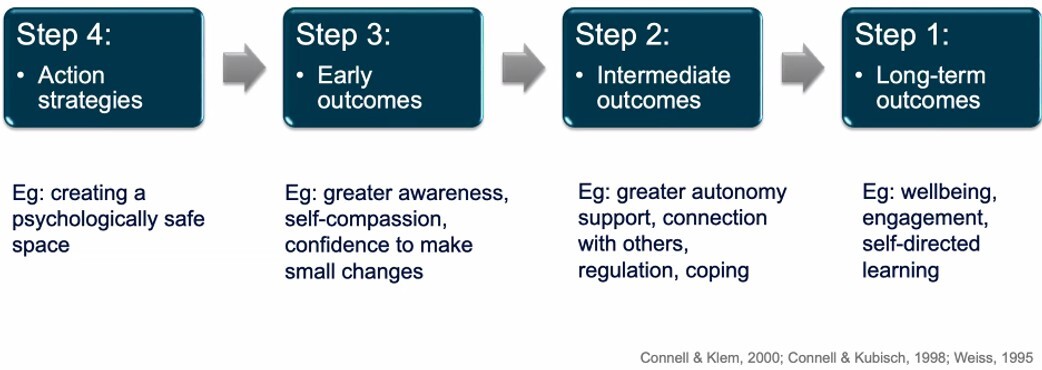
A Theory of Change (ToC) is an explicit articulation of how and why a desired change is expected to happen in a particular context. Rather than starting with programs and hoping they produce results, a ToC works in the opposite direction: it begins with the long-term outcome you want to achieve and works backwards to identify the preconditions, processes and actions required to get there, making the underlying assumptions visible at every step (Weiss, 1995; Connell and Klem, 2000).

TOCbackwards

A ToC is developed by starting with the change you want to see and working backwards to identify the actions required to enable it. Dr TC described four steps:

1. Long-term outcomes (What change do we want to see?): Examples include sustained wellbeing, reduced loneliness, stronger community connectedness, or reduced distress. These outcomes anchor the entire design process.

2. Processes (What enables those outcomes?): Processes include meaningful connection, emotion regulation, autonomy support, coping, and the development of staff and student agency and identity. These are the mechanisms through which long-term change occurs.

3. Structural conditions (What needs to be in place?): Earlier-stage outcomes such as situational awareness, emotional awareness, empathy, self-compassion and the confidence to make small adjustments. These create the foundation for the processes above.

4. Actions (Where do we begin?): Concrete strategies, starting with the creation of psychologically safe spaces for staff and students. Working backwards ensures that actions are grounded in a clear theoretical foundation rather than driven by available programs.

 The SyInC-ToC Framework 

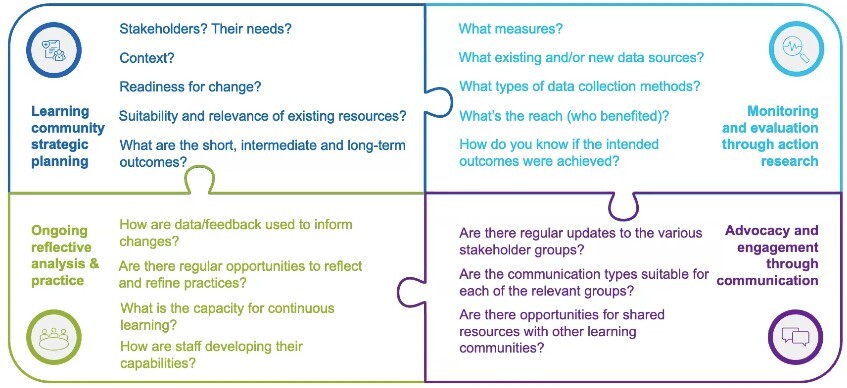
The SyInC–ToC framework represents a contextualised application of this methodology to Australian learning communities - situating Theory of Change within a systems-informed approach that considers individual and systemic contributions together. For Australian educators and learning community leaders, SyInC–ToC offers three practical benefits:

1. Clarity of purpose: clearly defining what change is intended and the reasoning behind it

2. Better evaluation: setting out the logic for how change is expected to happen, so outcomes can be meaningfully assessed

3. Stakeholder alignment: building a shared understanding across students, staff, families, community, and government partners.

framework

The System and Individual contributions to learning Communities using Theory of Change (SyInC-ToC) Framework (Chin et. al., 2022)

Case Study:  Maroondah City Council

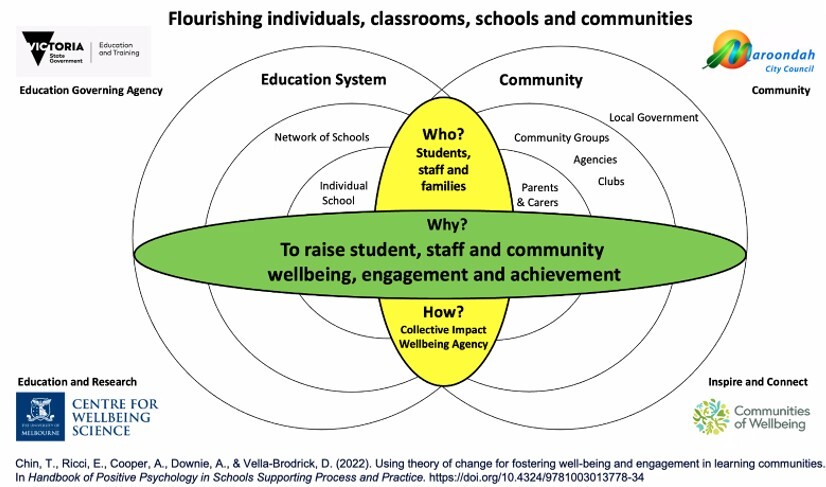
Sustainable change in educational communities rarely succeeds in isolation. Drawing on Bronfenbrenner's ecological systems theory, students and staff are embedded within interconnected systems - families, schools, communities and policy environments - and meaningful change requires engaging across these layers.

Maroondah


Partnering with parents, neighbouring schools, local government and community organisations expands available resources, surfaces hidden assumptions, and distributes responsibility for wellbeing beyond individual educators. When stakeholders are involved in the design, implementation and evaluation of initiatives, not just their delivery, change becomes more context-responsive, equitable and enduring. Dr TC discussed the importance of identifying and involving each of the stakeholders in Maroondah City Council’s vision to raise student, staff and community wellbeing, engagement and achievement. 


Maroondah City Council Positive Education Initiative

The initiative outlines a collective, community-wide approach to embedding wellbeing as a core purpose of education, not an add-on. It seeks to establish a shared vision across schools, families, and community organisations to ensure young people develop into the best versions of themselves, with wellbeing integrated into everyday learning and culture. A key aim is to create a sustainable, large-scale model that builds local capacity, aligns stakeholders, and drives long-term cultural change in how education supports both wellbeing and learning.

Author/Source: Anthony Raitman, Maroondah City Council

Last updated: 01/01/2024

Maroondah City Council Positive Education Initiative

Practical Resource: The Systems Iceberg Relfection Tool

To assist in strategic planning and identifying what changes are required to improve wellbeing, Dr TC drew on the systems iceberg model to illustrate how observable events are underpinned by less visible patterns, structures and mental models (Senge, 1990).

Without engaging with these deeper layers, wellbeing initiatives risk addressing symptoms while leaving the conditions that produce them intact.   Four reflection questions to guide application within your learning community:

1. What specific behaviours or trends are you noticing in your community?

2. How do your school's daily routines and practices support or hinder staff and student wellbeing?

3. How are policies, resource allocation and organisational structure influencing wellbeing initiatives and outcomes?

4. What core beliefs or assumptions about wellbeing in education are driving decision-making?

Click the Learn more button below to dive deeper in your own context. Bring it to your next leadership or planning meeting and use it to surface the deeper patterns, structures and beliefs shaping wellbeing in your school community.


The Systems Iceberg Reflection Tool

A four-question reflection tool using Senge's systems iceberg model to help leaders and educators uncover the deeper structures and beliefs driving recurring wellbeing issues.

Author/Source: PESA

Last updated: 07/04/2026

The Systems Iceberg Reflection Tool

References and Additional Readings