
.svg)
Education for human flourishing: A conceptual framework
In the future, education systems should nurture a broader range of capabilities, help restore meaning to young people's lives and equip them with the skills and ambition to remake our societies, economies and organisations. To flourish over a lifetime, people will need to be adaptive problem solvers, ethically competent and able to understand, appreciate and act in the world. In the age of AI, education must strengthen human agency, human meaning and human security. Since 2020, the OECD has developing far-reaching ideas on the future purposes of education, based on policy dialogues with seven high performing PISA systems. The Human Capital model, which has shaped what students learn for many decades, prepares young people for yesterday's jobs, through cognitive examinations. Education for Human Flourishing will equip young people for lives of purpose and fulfilment. The framework is helping shape the international conversation about the future of education. It is a vital ingredient in the development of PISA and a contribution to national policymaking, for countries wishing to reorient education purposes, policies and practices. It will be of interest to ministers, officials, students, teachers, school leaders, researchers and education innovators.
Last updated: 01/07/2025

Related Resources

Research Summary
Student Flourishing in Australian Christian Schools
A landmark report exploring what helps adolescents flourish in Christian secondary schools across Australia. Drawing on one of the largest studies of its kind - a longitudinal survey of 22,092 students in Years 7–12 across 57 schools - the research identifies the conditions, practices and priorities that support students to flourish holistically: intellectually, socially, physically and spiritually. Author: Iselin, D.J. (2026). Student Flourishing in Australian Christian Schools Report. Christian Schools Australia. Canberra, ACT. Summary by PESA

Webinar/Video
2026 Online PD
Harnessing Collective Action to Sustain Wellbeing Initiatives in Learning Communities
Presented by Dr Tan-Chyuan Chin, PhD: Senior Lecturer in Wellbeing Science, The University of Melbourne. Optimising collaborative community practices in an interconnected learning system.

Article
PD Wrap Up
2026 PD Wrap Up: Harnessing Collective Action to Sustain Wellbeing Initiatives in Learning Communities
Ending our Term 1 focus on ‘building wellbeing communities from day one’, we welcomed Dr Tan Chyuan-Chin (TC), Senior Lecturer in Wellbeing Science to explore a systems-informed approach to strengthening and sustaining wellbeing initiatives. In this session, Dr TC contrasted isolated, program-led approaches to wellbeing with whole-of-community, systems-aligned models to design learning communities that support wellbeing from the ground up. Dr TC introduced the Theory of Change model and the SyInC-ToC framework as practical tools for planning, implementing and evaluating sustainable change. Author/Source: PESA and Dr Tan Chyuan-Chin, Senior Lecturer in Wellbeing Science.
%20(3).png)
Worksheet
The Systems Iceberg Reflection Tool
A four-question reflection tool using Senge's systems iceberg model to help leaders and educators uncover the deeper structures and beliefs driving recurring wellbeing issues. Author/Source: PESA
Article
2025 Conference
Conference 2025 Reflection, Outcomes and Resources
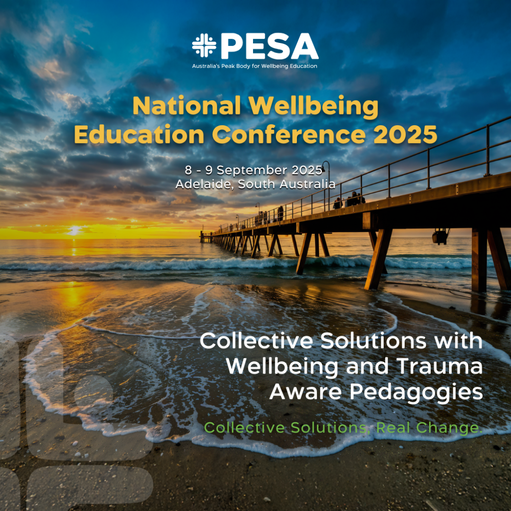
The 2025 National Wellbeing Education Conference was themed "Collective Solutions with Wellbeing and Trauma Aware Pedagogies" and held in Adelaide, South Australia on the 8th and 9th September. Learn more about the program, highlights, outcomes and resources from this remarkable event. Author/Source: PESA community: keynote speakers, masterclass and hackathon presenters.
Research Summary
Student Flourishing in Australian Christian Schools
A landmark report exploring what helps adolescents flourish in Christian secondary schools across Australia. Drawing on one of the largest studies of its kind - a longitudinal survey of 22,092 students in Years 7–12 across 57 schools - the research identifies the conditions, practices and priorities that support students to flourish holistically: intellectually, socially, physically and spiritually. Author: Iselin, D.J. (2026). Student Flourishing in Australian Christian Schools Report. Christian Schools Australia. Canberra, ACT. Summary by PESA
Access Resource
Webinar/Video
2026 Online PD
Harnessing Collective Action to Sustain Wellbeing Initiatives in Learning Communities
Presented by Dr Tan-Chyuan Chin, PhD: Senior Lecturer in Wellbeing Science, The University of Melbourne. Optimising collaborative community practices in an interconnected learning system.
Access Resource
Article
PD Wrap Up
2026 PD Wrap Up: Harnessing Collective Action to Sustain Wellbeing Initiatives in Learning Communities
Ending our Term 1 focus on ‘building wellbeing communities from day one’, we welcomed Dr Tan Chyuan-Chin (TC), Senior Lecturer in Wellbeing Science to explore a systems-informed approach to strengthening and sustaining wellbeing initiatives. In this session, Dr TC contrasted isolated, program-led approaches to wellbeing with whole-of-community, systems-aligned models to design learning communities that support wellbeing from the ground up. Dr TC introduced the Theory of Change model and the SyInC-ToC framework as practical tools for planning, implementing and evaluating sustainable change. Author/Source: PESA and Dr Tan Chyuan-Chin, Senior Lecturer in Wellbeing Science.
Access Resource
Worksheet
The Systems Iceberg Reflection Tool
A four-question reflection tool using Senge's systems iceberg model to help leaders and educators uncover the deeper structures and beliefs driving recurring wellbeing issues. Author/Source: PESA
Access Resource
Article
2025 Conference
Conference 2025 Reflection, Outcomes and Resources
The 2025 National Wellbeing Education Conference was themed "Collective Solutions with Wellbeing and Trauma Aware Pedagogies" and held in Adelaide, South Australia on the 8th and 9th September. Learn more about the program, highlights, outcomes and resources from this remarkable event. Author/Source: PESA community: keynote speakers, masterclass and hackathon presenters.
Access Resource