A Guide to Wellbeing Education
This guide introduces the core concepts and evidence behind wellbeing education including what it means, why it matters for students and staff, and the key considerations that underpin an effective whole-school approach.
What is Positive Education?
Definitions vary, but PESA frames positive education as: the application of wellbeing science and Positive Psychology within education to enhance student, staff and community wellbeing, boosting wellbeing and reducing ill-being.
It's an approach to designing educational environments that treat wellbeing and character development as core to academic achievement and lifelong flourishing, combining Positive Psychology with best-practice teaching (Norrish et al., 2013).
Positive Education vs. Wellbeing Education. What's the Difference?
The field has shifted from "positive education" (applying positive psychology principles) to the broader "wellbeing education" — encompassing strengths, resilience, whole-school systems, cultural perspectives, equity, and the interconnection of staff, students and community. This reflects wellbeing as a shared, integrated responsibility rather than a bolt-on programme.
PESA's Vision and Mission
-
Vision: To accelerate the prioritisation of evidence-informed wellbeing education for the future of Australians.
-
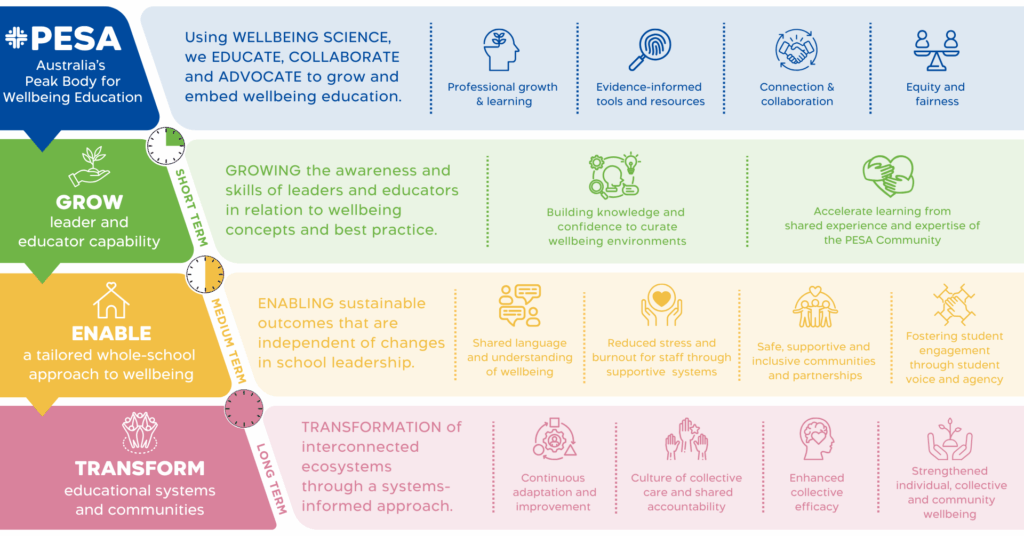
Mission: To advocate, educate and collaborate to grow and embed wellbeing education throughout Australia.
As a not-for-profit peak body, PESA helps schools embed wellbeing into practice through evidence-informed tools, professional learning and national advocacy - driving system-wide, long-term transformation.
“When educating the minds of our youth, we must not forget
to educate their hearts.”
- Dalai Lama
What Does a Flourishing School and Community Look Like?
A flourishing school is a dynamic, holistic state where a group is feeling good, functioning effectively, and doing good for others (Huppert, 2009), going beyond the absence of illness to genuine positive functioning and social participation. Key features:
-
Systems perspective: wellbeing of students, staff and families is interconnected (Kern & Wehmeyer, 2021; Cobo-Rendón et al., 2025)
-
"Learn it, Live it, Teach it, Embed it": staff model wellbeing before teaching it
-
Student agency and voice: flourishing is done with students, not to them
-
Inclusive environments: diversity as strength, belonging for all
Flourishing is often structured around frameworks like PERMA (see Wellbeing Frameworks Guide).
Collective Resilience: Flourishing as a Community
A flourishing community possesses the capacity for collective transformation and resilience (Kern & Wehmeyer, 2021; Cobo-Rendón et. al., 2025):
-
Collective identity: communities move from "self" to "we" under adversity
-
Shared responsibility: wellbeing as a mission shared across school, family and community
-
Ethical horizon: aiming for a "virtuous we-being," good for people and planet
Every interaction, from lessons to parent partnerships, builds an ecosystem of collective flourishing, preparing students for purposeful, productive lives as global citizens.
Why Wellbeing Matters in Education
Wellbeing isn't a programme. It's a culture, operating at community, whole-school, classroom and individual levels. Schools now support the whole child: social, emotional, physical and spiritual growth alongside academics (Kern & Wehmeyer, 2021; Baker et al., 2017; University of Melbourne, 2015).
Learning and wellbeing are deeply linked: positive emotional states support attention, memory and problem-solving, while stress and poor mental health hinder learning (Immordino-Yang et al., 2018; Waters, 2021). Student wellbeing is closely tied to educator wellbeing, supported teachers foster better relationships and inclusive classrooms.
Research over the years, and still developing, has indicated several benefits of a wellbeing initiatives for students and educators:
Theory:
- Proposes that humans have a fundamental motivation to belong - a need for frequent, affectively pleasant interactions with a few people in stable, enduring relationships.
Key Findings:
- A lack of belonging leads to anxiety, loneliness, and even physical illness.
- Belonging is as fundamental as the need for food or shelter.
Reference:
- Baumeister, R. F., & Leary, M. R. (1995). The need to belong: Desire for interpersonal attachments as a fundamental human motivation. Psychological Bulletin, 117(3), 497–529. https://doi.org/10.1037/0033-2909.117.3.497
Theory:
- Identifies relatedness (the desire to feel connected and cared for) as one of three basic psychological needs, alongside autonomy and competence.
- A strong sense of relatedness fosters intrinsic motivation and wellbeing.
Reference:
- Ryan, R. M., & Deci, E. L. (2000). Self-determination theory and the facilitation of intrinsic motivation, social development, and well-being. American Psychologist, 55(1), 68–78.
The Critical Role of Educator Wellbeing
Educators are the backbone of the school community, and their wellbeing is a critical determinant of high-quality education and positive social-academic outcomes (McCallum, 2021). Educator and child wellbeing are inextricably linked, particularly in settings where the adult's emotional state directly shapes the classroom climate and the learner's sense of safety (Baker et al., 2017; Immordino-Yang et al., 2019).
• Authentic Modeling: A fundamental role for staff is to "learn it and live it" before they "teach it and embed it" (Hoare et al., 2017). Students possess a "honed radar for authenticity" and benefit most from witnessing adults who model patient, safe, and flourishing behavior (Brunzell, 2021).
• Capacity for Care: There is a direct connection between an educator's personal wellbeing and their capacity to provide high-quality care, de-escalate student resistance, and maintain unconditional positive regard (Baker et al., 2017; Brunzell, 2021).
• Neural State for Teaching: Just as students require emotional stability to learn, teachers require it to provide effective emotional support and navigate the daily demands of an "intensely personal" vocation (Baker et al., 2017; Immordino-Yang et al., 2019).
ltimately, because "schools thrive when principals [and teachers] thrive," educator wellbeing must be treated as a collective responsibility of the entire system rather than just an individual burden (McCallum, 2021).
A whole-child and whole-staff perspective (whole-school approach) recognises the interconnectedness of academic, social, and emotional growth.
Wellbeing isn’t a program - it’s a culture.
What is a Whole School Approach?
To be effective, schools must adopt a systems-informed, whole-school approach that embeds wellbeing into the fabric of the entire community, including policy, culture, and both the "taught and caught" curriculum (Arguís-Rey, 2021; Runions et al., 2021).
This perspective views the school as a complex human social system where individual and collective flourishing are recognised as mutually dependent goals (Kern & Taylor, 2021; Runions et al., 2021).
Critically, wellbeing initiatives cannot be applied as a one-size-fits-all template; they must be context-based, responsive to the particular cultural, socioeconomic, and community realities of each school. A wellbeing approach that thrives in one setting may fail in another if it does not account for local values, language, family structures, and the lived experiences of students and staff. Genuine, sustainable impact depends on schools tailoring whole-school approaches to their own context, drawing on the strengths, needs, and cultural knowledge already present within their community, rather than importing generic programs.
More information about systems informed wellbeing in A guide to Wellbeing Science
Why Wellbeing Literacy Matters
Wellbeing doesn't just happen - it's built, in part, through the language we use to understand and express it. Wellbeing literacy is defined as the capability to comprehend and compose wellbeing-related language across contexts, with the intention of maintaining or improving the wellbeing of oneself, others, or the world (Oades et al., 2021). In practical terms, it's the ability to recognise, name, and communicate about wellbeing in ways that are genuinely useful - not just knowing the vocabulary, but knowing how and when to use it.
This matters because language is one of the few levers available at a whole-population scale for shifting wellbeing outcomes. Oades et al. (2021) argue that achieving population-level wellbeing requires a ubiquitous systemic lever, and that intentional language use represents exactly that. For schools, this reframes wellbeing education: it's not only about teaching students what wellbeing is, but building their capacity to talk about it — to themselves, to peers, and to the adults around them — in ways that are context-sensitive and genuinely supportive (Oades & Jarden, 2021).
The evidence base is growing quickly. Hou et al. (2021) tested a six-item wellbeing literacy scale across three large Australian samples — students, parents, and school staff — and found wellbeing literacy to be empirically distinct from general wellbeing, resilience, and emotion regulation, while also predicting meaningful variance in wellbeing and illbeing beyond those established constructs. In other words, teaching people to comprehend and compose wellbeing language isn't a soft add-on — it does distinct, measurable work.
For schools, the practical implication is clear: professional learning and curriculum design should build staff and student capacity not just to experience wellbeing practices, but to talk about them fluently — recognising emotional states, naming strengths, and communicating support in ways tailored to the person and moment. That shared, intentional language is what turns individual wellbeing knowledge into a genuinely collective, whole-school capability.
Related Guides
- Creating a Positive Climate for Wellbeing, Engagement and Learning
References
Hou, H., Chin, T.-C., Slemp, G. R., & Oades, L. G. (2021). Wellbeing literacy: Conceptualization, measurement, and preliminary empirical findings from students, parents and school staff. International Journal of Environmental Research and Public Health, 18(4), 1485. https://doi.org/10.3390/ijerph18041485
Oades, L. G., & Jarden, A. (2021). Wellbeing literacy and positive education. In M. L. Kern & M. L. Wehmeyer (Eds.), The Palgrave handbook of positive education (pp. 327–345). Palgrave Macmillan.
Oades, L. G., Jarden, A., Hou, H., Ozturk, C., Williams, P., Slemp, G. R., & Huang, L. (2021). Wellbeing literacy: A capability model for wellbeing science and practice. International Journal of Environmental Research and Public Health, 18(2), 719. https://doi.org/10.3390/ijerph18020719
Resources in this guide
Supporting student wellbeing: Understanding the pressures shaping youth mental health
Getting Started with Positive Education
What is Positive Education?
The Palgrave Handbook of Positive Education
Supporting student wellbeing: Understanding the pressures shaping youth mental health
Getting Started with Positive Education
What is Positive Education?
The Palgrave Handbook of Positive Education
Content goes here...